 Add to Chrome
 Add to Firefox
 Add to Edge
JetViT: Efficient High-Resolution Vision Transformer with Post-Training Attention Search
May 26, 2026
We introduce JetViT, a novel family of hybrid-architecture Vision Transformer (ViT) models that match the accuracy of state-of-the-art full-attention vision foundation models while achieving substantially higher inference efficiency on high-resolution images. At the core of our approach is Post-Training Attention Search, a post-training acceleration framework that converts pre-trained full-attention ViTs into efficient hybrid-attention variants by identifying and replacing redundant full-attention blocks with linear or window-attention blocks. By inheriting the MLP and attention weights from the base model, Post-Training Attention Search efficiently explores the architectural design space through three key steps: (1) optimizing the linear-attention block design; (2) finding the best combination of linear-attention and window-attention blocks; and (3) identifying and preserving critical full-attention blocks. We evaluate JetViT on two representative high-resolution vision foundation models, DINOv3 and DepthAnythingV2. On the NVIDIA H100 GPU, JetViT achieves up to 1.79x higher throughput and up to 44.81% lower latency without sacrificing accuracy. We will release our code and accelerated ViT models soon.

Hide to Guide: Learning via Semantic Masking
May 24, 2026Reinforcement learning with verifiable rewards (RLVR) has become a powerful paradigm for improving language models on reasoning-intensive tasks, but its effectiveness is often limited by exploration. For example, models often fail on hard problems, leaving little useful reward signal. External expert traces offer a natural source of guidance, yet they may also expose reward-relevant content along the critical path to the verifier target, such as final answers, intermediate values, executable implementations, or answer-related entities. This content can create an unintended reward hacking channel, allowing the policy to obtain reward by copying the trace rather than learning the underlying reasoning or agentic behavior. Existing guided-RL methods reduce this risk by using partial trajectories, but they mainly control how much expert information is shown heuristically rather than which parts should be hidden. To this end, we propose Semantic Masked Expert Policy Optimization (SMEPO), a fine-grained semantic masking strategy for expert-guided RLVR. Instead of truncating traces coarsely or revealing them unchanged, SMEPO masks reward-relevant semantic spans along the critical path while preserving the expert's decomposition, plan, and procedural structure. This turns hard problems from reasoning from scratch into a fill-in-the-blank process: the policy can follow the expert's problem-solving route, but must still reconstruct the missing values, code, or entities by itself. SMEPO is simple to apply and requires no changes to the reward function or RL objective. Across diverse domains, including math, code, and agentic search, SMEPO improves accuracy by up to 3.2 points over GRPO and reduces training time by up to 4.2x. The code is available at https://github.com/mit-han-lab/SMEPO.
AnyFlow: Any-Step Video Diffusion Model with On-Policy Flow Map Distillation
May 13, 2026Few-step video generation has been significantly advanced by consistency distillation. However, the performance of consistency-distilled models often degrades as more sampling steps are allocated at test time, limiting their effectiveness for any-step video diffusion. This limitation arises because consistency distillation replaces the original probability-flow ODE trajectory with a consistency-sampling trajectory, weakening the desirable test-time scaling behavior of ODE sampling. To address this limitation, we introduce AnyFlow, the first any-step video diffusion distillation framework based on flow maps. Instead of distilling a model for only a few fixed sampling steps, AnyFlow optimizes the full ODE sampling trajectory. To this end, we shift the distillation target from endpoint consistency mapping $(z_{t}\rightarrow z_{0})$ to flow-map transition learning $(z_{t}\rightarrow z_{r})$ over arbitrary time intervals. We further propose Flow Map Backward Simulation, which decomposes a full Euler rollout into shortcut flow-map transitions, enabling efficient on-policy distillation that reduces test-time errors (i.e., discretization error in few-step sampling and exposure bias in causal generation). Extensive experiments across both bidirectional and causal architectures, at scales ranging from 1.3B to 14B parameters, demonstrate that AnyFlow achieves performance matches or surpasses consistency-based counterparts in the few-step regime, while scaling with sampling step budgets.
Quant VideoGen: Auto-Regressive Long Video Generation via 2-Bit KV-Cache Quantization
Feb 03, 2026Despite rapid progress in autoregressive video diffusion, an emerging system algorithm bottleneck limits both deployability and generation capability: KV cache memory. In autoregressive video generation models, the KV cache grows with generation history and quickly dominates GPU memory, often exceeding 30 GB, preventing deployment on widely available hardware. More critically, constrained KV cache budgets restrict the effective working memory, directly degrading long horizon consistency in identity, layout, and motion. To address this challenge, we present Quant VideoGen (QVG), a training free KV cache quantization framework for autoregressive video diffusion models. QVG leverages video spatiotemporal redundancy through Semantic Aware Smoothing, producing low magnitude, quantization friendly residuals. It further introduces Progressive Residual Quantization, a coarse to fine multi stage scheme that reduces quantization error while enabling a smooth quality memory trade off. Across LongCat Video, HY WorldPlay, and Self Forcing benchmarks, QVG establishes a new Pareto frontier between quality and memory efficiency, reducing KV cache memory by up to 7.0 times with less than 4% end to end latency overhead while consistently outperforming existing baselines in generation quality.
Jet-RL: Enabling On-Policy FP8 Reinforcement Learning with Unified Training and Rollout Precision Flow
Jan 20, 2026Reinforcement learning (RL) is essential for enhancing the complex reasoning capabilities of large language models (LLMs). However, existing RL training pipelines are computationally inefficient and resource-intensive, with the rollout phase accounting for over 70% of total training time. Quantized RL training, particularly using FP8 precision, offers a promising approach to mitigating this bottleneck. A commonly adopted strategy applies FP8 precision during rollout while retaining BF16 precision for training. In this work, we present the first comprehensive study of FP8 RL training and demonstrate that the widely used BF16-training + FP8-rollout strategy suffers from severe training instability and catastrophic accuracy collapse under long-horizon rollouts and challenging tasks. Our analysis shows that these failures stem from the off-policy nature of the approach, which introduces substantial numerical mismatch between training and inference. Motivated by these observations, we propose Jet-RL, an FP8 RL training framework that enables robust and stable RL optimization. The key idea is to adopt a unified FP8 precision flow for both training and rollout, thereby minimizing numerical discrepancies and eliminating the need for inefficient inter-step calibration. Extensive experiments validate the effectiveness of Jet-RL: our method achieves up to 33% speedup in the rollout phase, up to 41% speedup in the training phase, and a 16% end-to-end speedup over BF16 training, while maintaining stable convergence across all settings and incurring negligible accuracy degradation.
Win Fast or Lose Slow: Balancing Speed and Accuracy in Latency-Sensitive Decisions of LLMs
May 26, 2025Large language models (LLMs) have shown remarkable performance across diverse reasoning and generation tasks, and are increasingly deployed as agents in dynamic environments such as code generation and recommendation systems. However, many real-world applications, such as high-frequency trading and real-time competitive gaming, require decisions under strict latency constraints, where faster responses directly translate into higher rewards. Despite the importance of this latency quality trade off, it remains underexplored in the context of LLM based agents. In this work, we present the first systematic study of this trade off in real time decision making tasks. To support our investigation, we introduce two new benchmarks: HFTBench, a high frequency trading simulation, and StreetFighter, a competitive gaming platform. Our analysis reveals that optimal latency quality balance varies by task, and that sacrificing quality for lower latency can significantly enhance downstream performance. To address this, we propose FPX, an adaptive framework that dynamically selects model size and quantization level based on real time demands. Our method achieves the best performance on both benchmarks, improving win rate by up to 80% in Street Fighter and boosting daily yield by up to 26.52% in trading, underscoring the need for latency aware evaluation and deployment strategies for LLM based agents. These results demonstrate the critical importance of latency aware evaluation and deployment strategies for real world LLM based agents. Our benchmarks are available at Latency Sensitive Benchmarks.
Sparse VideoGen2: Accelerate Video Generation with Sparse Attention via Semantic-Aware Permutation
May 24, 2025Diffusion Transformers (DiTs) are essential for video generation but suffer from significant latency due to the quadratic complexity of attention. By computing only critical tokens, sparse attention reduces computational costs and offers a promising acceleration approach. However, we identify that existing methods fail to approach optimal generation quality under the same computation budget for two reasons: (1) Inaccurate critical token identification: current methods cluster tokens based on position rather than semantics, leading to imprecise aggregated representations. (2) Excessive computation waste: critical tokens are scattered among non-critical ones, leading to wasted computation on GPUs, which are optimized for processing contiguous tokens. In this paper, we propose SVG2, a training-free framework that maximizes identification accuracy and minimizes computation waste, achieving a Pareto frontier trade-off between generation quality and efficiency. The core of SVG2 is semantic-aware permutation, which clusters and reorders tokens based on semantic similarity using k-means. This approach ensures both a precise cluster representation, improving identification accuracy, and a densified layout of critical tokens, enabling efficient computation without padding. Additionally, SVG2 integrates top-p dynamic budget control and customized kernel implementations, achieving up to 2.30x and 1.89x speedup while maintaining a PSNR of up to 30 and 26 on HunyuanVideo and Wan 2.1, respectively.
Scaling Vision Pre-Training to 4K Resolution
Mar 25, 2025High-resolution perception of visual details is crucial for daily tasks. Current vision pre-training, however, is still limited to low resolutions (e.g., 378 x 378 pixels) due to the quadratic cost of processing larger images. We introduce PS3 that scales CLIP-style vision pre-training to 4K resolution with a near-constant cost. Instead of contrastive learning on global image representation, PS3 is pre-trained by selectively processing local regions and contrasting them with local detailed captions, enabling high-resolution representation learning with greatly reduced computational overhead. The pre-trained PS3 is able to both encode the global image at low resolution and selectively process local high-resolution regions based on their saliency or relevance to a text prompt. When applying PS3 to multi-modal LLM (MLLM), the resulting model, named VILA-HD, significantly improves high-resolution visual perception compared to baselines without high-resolution vision pre-training such as AnyRes and S^2 while using up to 4.3x fewer tokens. PS3 also unlocks appealing scaling properties of VILA-HD, including scaling up resolution for free and scaling up test-time compute for better performance. Compared to state of the arts, VILA-HD outperforms previous MLLMs such as NVILA and Qwen2-VL across multiple benchmarks and achieves better efficiency than latest token pruning approaches. Finally, we find current benchmarks do not require 4K-resolution perception, which motivates us to propose 4KPro, a new benchmark of image QA at 4K resolution, on which VILA-HD outperforms all previous MLLMs, including a 14.5% improvement over GPT-4o, and a 3.2% improvement and 2.96x speedup over Qwen2-VL.
Sparse VideoGen: Accelerating Video Diffusion Transformers with Spatial-Temporal Sparsity
Feb 03, 2025
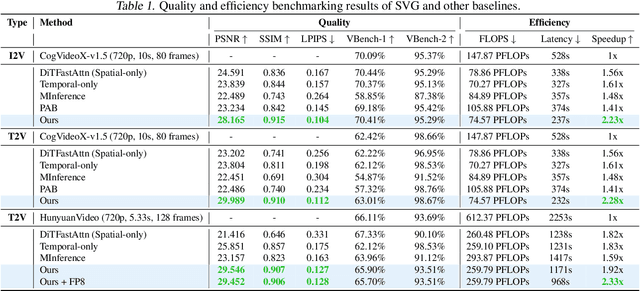

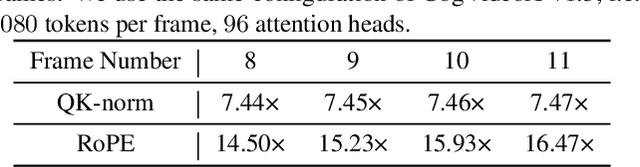
Diffusion Transformers (DiTs) dominate video generation but their high computational cost severely limits real-world applicability, usually requiring tens of minutes to generate a few seconds of video even on high-performance GPUs. This inefficiency primarily arises from the quadratic computational complexity of 3D Full Attention with respect to the context length. In this paper, we propose a training-free framework termed Sparse VideoGen (SVG) that leverages the inherent sparsity in 3D Full Attention to boost inference efficiency. We reveal that the attention heads can be dynamically classified into two groups depending on distinct sparse patterns: (1) Spatial Head, where only spatially-related tokens within each frame dominate the attention output, and (2) Temporal Head, where only temporally-related tokens across different frames dominate. Based on this insight, SVG proposes an online profiling strategy to capture the dynamic sparse patterns and predicts the type of attention head. Combined with a novel hardware-efficient tensor layout transformation and customized kernel implementations, SVG achieves up to 2.28x and 2.33x end-to-end speedup on CogVideoX-v1.5 and HunyuanVideo, respectively, while preserving generation quality.
SANA 1.5: Efficient Scaling of Training-Time and Inference-Time Compute in Linear Diffusion Transformer
Jan 30, 2025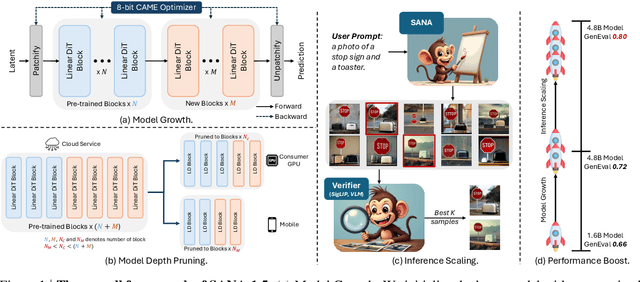


This paper presents SANA-1.5, a linear Diffusion Transformer for efficient scaling in text-to-image generation. Building upon SANA-1.0, we introduce three key innovations: (1) Efficient Training Scaling: A depth-growth paradigm that enables scaling from 1.6B to 4.8B parameters with significantly reduced computational resources, combined with a memory-efficient 8-bit optimizer. (2) Model Depth Pruning: A block importance analysis technique for efficient model compression to arbitrary sizes with minimal quality loss. (3) Inference-time Scaling: A repeated sampling strategy that trades computation for model capacity, enabling smaller models to match larger model quality at inference time. Through these strategies, SANA-1.5 achieves a text-image alignment score of 0.72 on GenEval, which can be further improved to 0.80 through inference scaling, establishing a new SoTA on GenEval benchmark. These innovations enable efficient model scaling across different compute budgets while maintaining high quality, making high-quality image generation more accessible.